Caixabank (Go to Home)

 Print page
14 October 2026, 16:55h
|
min read
FINANCIAL PRODUCTS
National
Nearly 50% of Family Office Wealth is allocated to Private Markets, according to an IE University Report
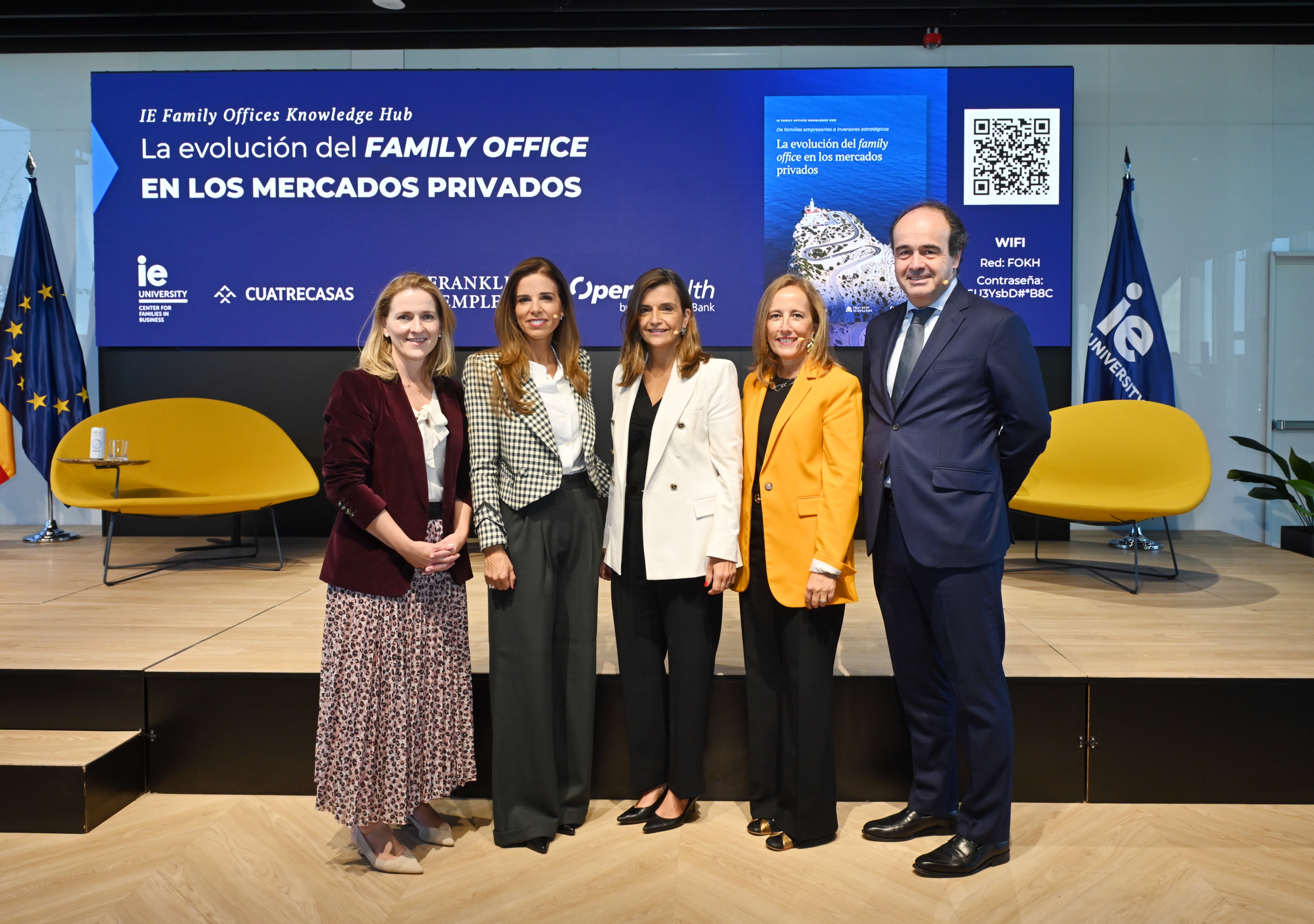
From left to right: Nancy Cueto, Deputy Vice President of the IE Foundation; Ana Álvarez, Head of Sales for Iberia at Franklin Templeton; Cristina Cruz, Director of the IE Center for Families in Business; Marta Alonso, Managing Director of Openwealth (CaixaBank Group); and Carlos Ferrer, Partner at Cuatrecasas
From left to right: Nancy Cueto, Deputy Vice President of the IE Foundation; Ana Álvarez, Head of Sales for Iberia at Franklin Templeton; Cristina Cruz, Director of the IE Center for Families in Business; Marta Alonso, Managing Director of Openwealth (CaixaBank Group); and Carlos Ferrer, Partner at Cuatrecasas
- Family offices allocate an average of 48.2% of their portfolios to private markets, and this commitment is growing: 54% of respondents plan to increase their exposure over the next five years. In Spain, the percentage planning an increase rises to 68.1%.
- Unlike other studies focused primarily on asset allocation, the report analyzes how family offices make investment decisions and what capabilities they develop as their experience grows.
- The first report by the IE Family Offices Knowledge Hub is based on a survey of 157 family offices worldwide and 27 in-depth interviews.
Family offices allocate an average of 48.2% of their portfolios to private markets, and more than half plan to increase their exposure over the next five years, while none expect to reduce it. In Spain, this trend is even more pronounced: 68.1% of surveyed family offices plan to increase their allocation to private markets, making them a central part of their investment strategy.
These are some of the main conclusions of the report "The Evolution of the Family Office in Private Markets: From Business-Owning Families to Strategic Investors", the first study developed by the IE Family Offices Knowledge Hub. Promoted by IE University, Cuatrecasas, Franklin Templeton, and OpenWealth (CaixaBank Group), the research is based on an international survey of 157 single-family offices in Europe, North America, Latin America, Asia, and the Middle East, following 27 in-depth interviews and an analysis of historical investment data.
The report was presented today at IE Tower, IE University's campus in Madrid, to family office representatives and industry professionals from various countries. The event featured Carlo Bonomi, Managing Director of Investindustrial, who shared his experience and perspective on the evolution of family offices as investors in private markets.
The study shows a close relationship between exposure to private markets and the development of internal capabilities. The average allocation to private markets rises from 44.9% among family offices with one or two specialized professionals to 62.9% among those with teams of six or more people.
By asset class, private equity (16.1%) and real estate (15.1%) account for the largest shares, while more than 60% of respondents report being satisfied or highly satisfied with the returns. These investors also have a clear international orientation: none of the family offices in the sample invest exclusively in their domestic market.
Cristina Cruz, academic director of the IE Family Offices Knowledge Hub, points out that "family offices have already incorporated private markets into their portfolios. The real challenge now is not accessing more opportunities, but building the governance, processes, and capabilities that allow them to transition from business-owning families to strategic investors. Our study shows that this evolution does not happen all at once, but through a learning process in which families progressively develop the capabilities necessary to invest with discipline and in a sustainable manner."
Unlike studies focused exclusively on asset allocation, the report analyzes how family offices make investment decisions and how their capabilities evolve as they gain experience. The results show that professionalization does not necessarily imply a loss of family control: in 52% of family offices, the final decision remains in the hands of the family, and only 10% fully delegate this responsibility. In Spain, the final investment decision rests directly with family members in 61% of the family offices surveyed.
Beyond portfolio data, the report identifies four stages in the evolution from business-owning families to strategic investors in private markets. Based on this analysis, the IE Family Offices Knowledge Hub proposes four practical systems: an investment policy, a governance model, a capital cycle management system, and a wealth architecture, to help families build long-term, sustainable investment structures.
"Family offices are evolving toward increasingly sophisticated wealth management models. This transformation requires integrating private market investment within a global vision of wealth, supported by solid governance and long-term planning. At OpenWealth, we help business-owning families face this process with a wealth consulting proposition that combines experience, specialization, and a comprehensive view of family wealth," said Marta Alonso, general manager of OpenWealth (CaixaBank Group).
"Family offices are a unique category of investor, with their own objectives, time horizons, and decision-making processes. Studies like this allow us to delve deeper into that reality, identify how their priorities are evolving, and better understand the challenges and opportunities they face. In an increasingly complex private markets ecosystem, asset managers play a key role not only by facilitating access and infrastructure, but also by helping families develop their investment capabilities and evolve their programs toward more sophisticated and diversified strategies," said Javier Villegas, Head of Iberia and Latam at Franklin Templeton.
"The challenge for family offices is no longer just identifying investment opportunities but equipping themselves with the legal and governance structures necessary to manage wealth with a vision of generational continuity," according to Carlos Ferrer, partner at Cuatrecasas.
Spanish Family Offices
The analysis of Spain reveals a young family office ecosystem, but with a strong commitment to private markets. Of the Spanish family offices surveyed, 41.2% were established after 2015, and 53% represent first-generation families. Despite their shorter history, 71.7% invest in private markets and allocate an average of 47.2% of their portfolios to them. Within this allocation, real estate assets rank first at 16.2%, followed by private equity (13.2%) and venture capital (10.5%), which accounts for a significantly larger share than in the rest of the sample.
The outlook is also clearly expansive: 68.1% expect to increase their exposure over the next five years, compared to 53.4% in the international sample. Satisfaction with returns is also notably high: nearly one in four (23.5%) is very satisfied, compared to 7.1% in the rest of the sample.
Professionalization does not necessarily mean less family participation in investment decisions. In Spain, the final decision rests directly with family members in 61% of the family offices surveyed.
About IE Family Offices Knowledge Hub
The IE Family Offices Knowledge Hub is an initiative of IE University together with Cuatrecasas, Franklin Templeton, and OpenWealth, that aims to contribute to the development of family offices through rigorous research, applied knowledge, and the exchange of experiences among business-owning families, professionals, and experts.