Caixabank (Go to Home)
 Print page
01 October 2026, 11:00h
|
min read
CORPORATE
SUSTAINABILITY
National
CaixaBank promotes projects that avoid 4,181,707 tonnes of CO₂ per year and contribute to creating or maintaining more than 51,800 jobs
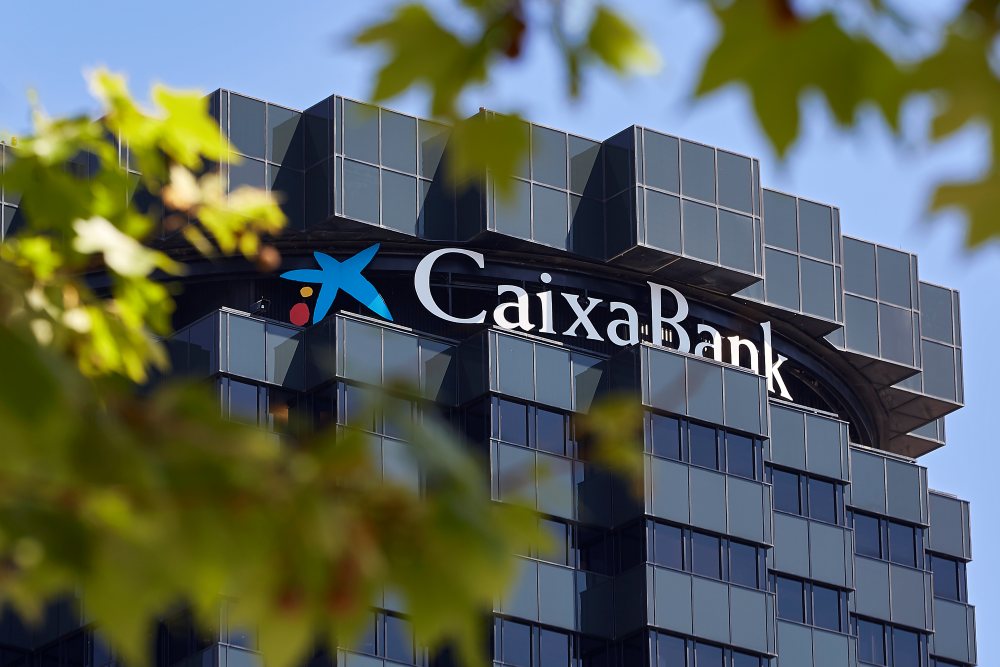
CaixaBank building in Barcelona (Spain)
CaixaBank building in Barcelona (Spain)
- CaixaBank's new social and green bond impact reports highlight that, at the end of 2025, the bank has nearly €30 billion in eligible assets backing the issuance of its sustainable bonds, 29.5% more than a year earlier
- CaixaBank's eligible social portfolio, of €12.03 billion, includes operations with 598,733 customers, includes 683,329 loans for initiatives with social impact and that have contributed to creating or maintaining more than 51,800 jobs
- The eligible green portfolio reaches €17.9 billion and is associated with a sustainable energy impact equivalent to the annual electricity consumption of nearly 4.2 million European households and avoiding the emission of 4.18 million tonnes of CO₂ per year
CaixaBank has published its new green and social bond impact reports, which include the main environmental and social results associated with the portfolios of eligible assets identified for the issuance of sustainable bonds by the bank as of December 31, 2025.
On that date, CaixaBank has nearly €30 million in assets eligible for green and social bonds, 29.5% more than a year earlier. The reports show how the operations included in these portfolios are linked to projects and activities with measurable results in areas such as renewable energy generation, energy efficiency of buildings, clean mobility, wastewater treatment, waste recycling, financial inclusion, entrepreneurship, employment, health, education and social housing.
Among the main impacts associated with the eligible green and social portfolios is the avoidance of the emission of 4,181,707 tonnes of CO₂ equivalent to the year and the estimated creation or maintenance of 51,802 jobs, respectively.
The social bonds report also incorporates the results of satisfaction surveys of households and businesses, for certain social categories, in relation to the impact that financing has had on their projects.
CaixaBank was the first Spanish bank to issue a social bond in September 2019, a month after the publication of its Sustainable bond issuance framework. Since then, the bank has issued 16 ESG-based issues, nine green bonds and seven social bonds, for a total volume of €15.4 billion. At the end of December 2025, the outstanding balance of green and social bonds issued amounted to approximately €11,750 million.
Social finance to expand opportunities and access to essential services
The CaixaBank Eligible Social Porfolio at the end of 2025 amounts to €12,030 million, 24% more than in 2024. It includes 683,329 loans, more than 20% above the previous year, and is associated with 598,733 customers. This funding includes initiatives aimed at facilitating access to essential services, supporting business activity, promoting financial inclusion, promoting equal opportunities and reducing inequalities.
The main category corresponds to the Financing of the self-employed workers, micro, small and medium-sized businesses, linked to SDG 8, Decent work and economic growth. The portfolio identified in this area amounts to €5,142 million, 12% more than in 2024, and includes 106,366 loans associated with 83,843 customers. According to the estimates included in the report, this category is linked to the creation or maintenance of 51,802 jobs and an estimated contribution of more than €7,400 million to Spanish GDP.
The report also analyzes the evolution of the businesses that have received this funding. Among the companies surveyed, 57% of micro-enterprises and 59.1% of SMEs say that their business was strengthened during the twelve months after the loan was granted.
The second largest social category corresponds to the Access to essential services (financing and financial services) for vulnerable groups, linked to SDG 1, No Poverty. Its eligible portfolio amounts to €2,925 million, 30% more than in 2024, and includes 536,142 loans associated with 479,229 customers. Of the total volume, €254 million correspond to financing for families living in rural or low-density areas and another €565 million to the acquisition of means of transport to improve mobility and promote social integration.
The results of the surveys round out the financial indicators in this category. Among the people surveyed, 85% consider that the loan had a positive impact on their family's financial situation, 91% say that it had a positive effect on their well-being and that of their family and 95% say that they have fully or partially achieved the objective for which they requested financing.
In the field of Healthcare, linked to SDG 3, the eligible portfolio reaches €1,649 million, 35% more than in 2024, and comprises 87 financings. The operations included in this category are associated with 41,635 hospital and health centre beds, nearly 20.8 million medical cares, 2,076 medical teams and the training of 30,587 health professionals. The projects are aimed at improving the population's access to health care, with special attention to the elderly and other vulnerable groups.
Education, linked to SDG 4, has an eligible portfolio of €685 million, 282% more than in 2024, making it the fastest growing social category during the year. The funding included in this category is associated with 179,206 students, 154 schools and 6,754 families, and includes both funding from schools and loans to facilitate access to higher education and vocational training.
The category intended for the Socioeconomic advancement and empowerment, linked to SDG 5, Gender equality, reaches €1,052 million, 8% more than the previous year. It includes 28,476 loans associated with 23,945 beneficiaries, including self-employed women and women-owned businesses.
Surveys carried out in this category show that 31% of the self-employed women beneficiaries consider that the loan contributed to improving their quality of life. Among the SMEs led by women surveyed, 60.6% say that their business was strengthened during the twelve months after the financing was granted.
Funding linked to SDG 10, Reduced inequalities, amounts to €217 million and is intended for foundations, non-profit institutions and socio economy organisations. The initiatives promoted by these organizations are associated with more than 2.9 million beneficiaries.
For its part, the category of Affordable housing and DANA relief, linked to SDG 11, Sustainable cities and communities, has an eligible portfolio of €363 million. The financing for affordable housing is associated with the construction of 4,696 new subsidized housing, while that linked to the DANA relief has made it possible to support 4,096 beneficiaries affected by the storm.
Financing to boost the energy transition
The CaixaBank Identified Green Portfolio at the end of 2025 amounts to €17,900 million, 33% more than in 2024. It is made up of 25,381 financial transactions, 44% more than the previous year, and focuses mainly on renewable energies and energy efficiency, green buildings and clean transport.
The financing included in this portfolio is associated with ceasing to emit 4,181,707 tonnes of CO₂ equivalent to the year, a figure comparable to the annual emissions generated by 975,405 passenger cars.
Renewable energy generation and avoided energy consumption add up to an energy impact of 15,108 GWh per year, equivalent to the annual electricity consumption of 4.19 million European households.
The category of Renewable energy and energy efficiency, linked to SDG 7, Affordable and Clean Energy, represents the largest volume of the green portfolio. It reaches €9,660 million, 34% more than in 2024, and includes 188 operations associated with an installed capacity of 7.1 GW, an annual generation of 15,056 GWh and avoided emissions of 3.9 million tonnes of CO₂ equivalent to one year.
The Green buildings constitute the second major category of the portfolio. Linked to SDGs 7 and SDG 11, it has €6,570 million, 44% more than the previous year, and includes 25,132 residential mortgage and commercial real estate loans. This financing will avoid an estimated energy consumption of 51.4 GWh per year, as well as the emission of 9,960 tonnes of CO₂ equivalent per year.
Funding for the Clean Transportation, which contributes to SDG 9, Industry, innovation and infrastructure, and SDG 11, Sustainable cities and communities, amounts to €1,580 million, 26% more than in 2024. The operations included in this category are associated with 749.6 million passenger-kilometers per year through sustainable modes of transport and an estimated 243,610 tons of CO emissions₂ equivalent per year.
The report also incorporates indicators on the Sustainable water and wastewater management and wastewater, linked to SDG 6, Clean water and sanitation. This category has an eligible portfolio of €27.7 million and is associated with the treatment of 6.4 cubic hectometres of wastewater per year, the annual supply of 2.76 cubic hectometres of water and an estimated reduction in emissions of approximately 375 tonnes of CO₂ equivalent to one year.
The category of Pollution prevention and control, linked to SDG 12, Responsible Consumption and Production, joins the Framework for the first time and reaches an eligible portfolio of €21.7 million. It comprises ten operations related to waste management, associated with the collection of 14,093 tonnes and the recycling of another 10,155 tonnes per year. Together, both magnitudes are equivalent to the waste generated annually by 54,860 people. The projects included in this category are also associated with the reduction of emissions of 3,562 tonnes of CO₂ equivalent to one year.
Sustainability, integrated into the strategy
CaixaBank is an entity with a strong historical link to the social impact of its activity, with the responsibility of promoting a positive economy for people's well-being.
With the 2025-2027 Sustainability Plan, which is part of CaixaBank's Strategic Plan, the bank has committed to mobilising more than €100,000 million in sustainable finance to continue moving towards a more sustainable economy and promote people's economic and social development, with the financing of renewable energy projects, clean mobility and efficient buildings, providing solutions that accelerate the sustainable transition of companies and families, promoting financial inclusion, favouring training and employment, and responding to the needs posed by growing longevity.
Since the launch of the 2025-2027 Sustainability Plan, CaixaBank has already mobilised €81,096 million in sustainable finance, more than 81% of the target set for the period as a whole. During the first half of 2026, mobilisation reached €34,928 million, 66% more than in the same period of the previous year and equivalent to 72% of the target set for 2026. As of June 2026, 19% of the bank's financial income was already generated by sustainable financing.