


 Caixabank (Go to Home)
 Print page
24 January 2020, 12:00h
|
min read
CORPORATE
International
CASABLANCA
CaixaBank and the Cervantes Institute drive the debate on business ethics in a new edition of the “Le Cercle” forums in Morocco
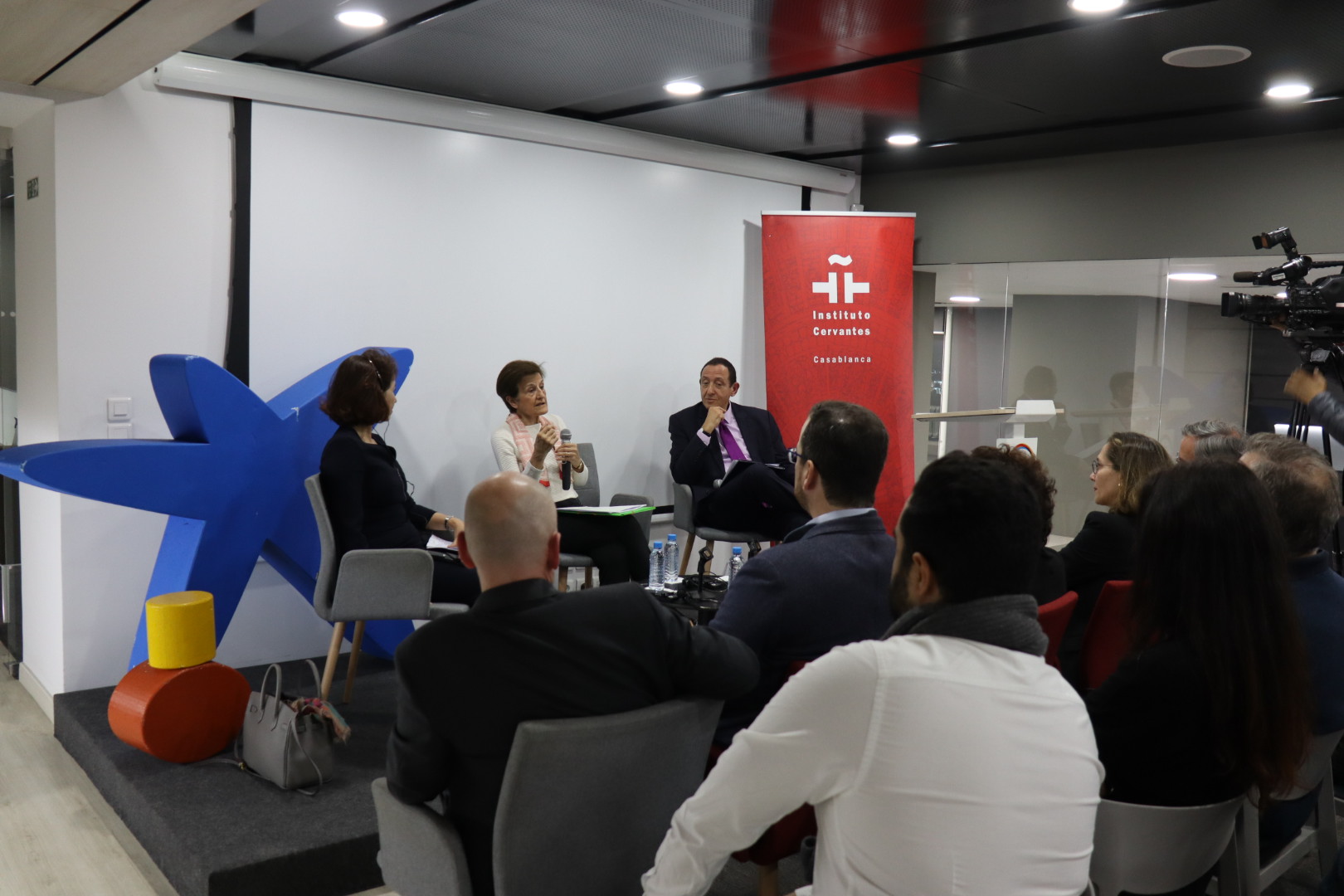
Le Cercle Casablanca - CaixaBank
Le Cercle Casablanca - CaixaBank
- Adela Cortina, Spanish philosopher and writer, and Dounia Taarji, president of the Hassan II Fund for the economic and social development of Morocco, were the guests invited to share their opinions on the importance of business ethics.
- This is the sixteenth edition of the "Le Cercle" discussion programme, held by CaixaBank in Morocco as a way of bringing together the Spanish-Moroccan business community and strengthening networking between the Spanish and Moroccan business worlds.
- CaixaBank is the leading issuer of guarantees for Spanish companies with projects in Morocco, reaching a market share of 60% in 2019.
Last night, CaixaBank and the Casablanca Cervantes Institute held a new edition of the Le Cercle discussion cycle, around the growing importance of business ethics in the current climate.
Adela Cortina, philosopher, writer and professor emeritus in ethics and political philosophy, and Dounia Taarji, president of the Hassan II Fund for the economic and social development of Morocco, were the public figures invited to share their opinions on business ethics in a round table discussion moderated by Ali Kadiri, business development and strategy consultant.
At the meeting, Adela Cortina highlighted the fact that “it is necessary to talk about the relationship between ethics and companies for at least two reasons: on the one hand, ethical strategies are profitable for companies in the mid- and long- term; and on the other, society needs ethical companies in order to prosper and evolve. They are two sides of the same coin. Companies that increasingly try to respond to the demands of their stakeholder groups increase their competitiveness, given that they are corporate citizens that generate alliances and not adversaries, and they also comprise a public asset, given that they benefit society at large.
For Taarji, “it is highly important to talk about business ethics because the excesses of globalisation have increased the need to reinstate the human element at the centre of company decisions. We see how the decisions of managers are increasingly assessed from a moral viewpoint”.
Adela Cortina is professor emeritus in ethics and political philosophy at the University of Valencia and the first woman to join the Spanish Academy of moral and political science. She is also head of the Étnor Foundation for business and organizational ethics. Her field of work is focused on ethics (on its principles and how it is applied in companies, policy, health, biotechnology, the media, professions and education) and on political philosophy (citizenship, democracy, human development and cosmopolitanism). She has written more than 50 books on ethical theory, such as Minimum ethics: Introduction to practical philosophy (1986), Applied ethics and radical democracy (1993), The ethics of cordial reason: educating in civic values in the twenty-first century (2014) and more recently, Aporophobia, the rejection of the poor (2017).
Dounia Taarji has been president of the directorate of the Hassan II Fund for the economic and social development of Morocco since February 2019. Her career began in the corporate banking sector in Paris. Now, back in Morocco, following the market reform, she created a brokerage firm and sits on the executive board of the Casablanca Stock Exchange. In 2001 she was appointed CEO of CDVM, the financial market regulatory authority, after which she carried out roles in the consultancy firms Monitor Group and Malya Conseil, until appointed president of the Hassan II Fund in 2019. Taarji is a graduate of the École Supérieure de Commerce in Paris. She holds a Diploma of Advanced Studies in commercial law from Paris-Sorbonne University and is a Harvard Business School Executive Program graduate.
Spanish-Moroccan discussion programme "Le Cercle"
This conference is part of the discussion programme "Le Cercle", which was created by CaixaBank as a way to bring together the Spanish-Moroccan business community and strengthen networking between the Spanish and Moroccan business worlds.
Since establishing this initiative in 2017, CaixaBank has held sixteen discussions focusing on various topics, from legal certainty and arbitration, to energy efficiency, the Moroccan currency, Moroccan taxation, and much more.
The meeting held yesterday is the second such event organised by the bank in collaboration with the Casablanca Cervantes Institute (Morocco), with the goal of diversifying the programme to also cover the latest social and cultural matters.
CaixaBank in Morocco
CaixaBank has been present in Morocco for more than ten years and currently has an office in Casablanca, with two operational branches located in the cities of Tangier and Agadir. From these branches it offers foreign trade services, business banking and corporate banking to Spanish companies already established in the country or looking to enter the Moroccan market, and to multinationals and Moroccan companies.
The entity has become established as a benchmark bank for Spanish companies in Morocco. In 2019, CaixaBank upheld its leadership in the market of issuing guarantees for Spanish companies with projects in the African country, with a market share of 60% for this kind of guarantee.
CaixaBank's international presence
CaixaBank's international presence is channelled through its International Banking network of representation branches and offices all around the world; and those of its subsidiary in Portugal, BPI.
CaixaBank's International Banking network comprises branches in Morocco, the United Kingdom, Germany, France and Poland. The bank also has 18 representation branches and 2 Spanish Desk centres spread across the 5 continents: Istanbul (Turkey), Beijing, Shanghai and Hong Kong (China), Singapore, Dubai (United Arab Emirates), New Delhi (India), Cairo (Egypt), Algiers (Algeria), Johannesburg (South Africa), New York (the USA), Santiago de Chile (Chile), Bogotá (Colombia), Sao Paulo (Brazil), Lima (Peru), Sidney (Australia) and Toronto (Canada).
Besides its branch network, CaixaBank holds agreements with international banks, making it easier for companies and individuals from any country in the world to engage in international transactions and foreign trade. Conversely, it has a 9.92% stake in the Austrian entity Esrte Bank.
Similarly, CaixaBank wholly owns Portugal's Banco BPI, the fifth largest financial institution operating in Portugal in terms of assets (€31.3 billion), with a 10% market share in customer deposits and lending. The bank has a workforce of nearly 5,000 people and has 500 branches in Portugal, serving 2 million customers.
About the Cervantes Institute
The Cervantes Institute is a public institution that was set up by Spain in 1991 to promote and teach Spanish and to spread the culture of Spain and Spanish-speaking countries. It essentially operates within the scope of the linguistic and cultural heritage shared by countries and people of the Spanish-speaking community. It operates in 87 centres in 44 countries spread across five continents. It has two offices in Spain: the head office in Madrid and an office in Alcalá de Henares. With more than 100,000 students a year, the Cervantes Institute is the largest global institution engaged in teaching Spanish.
Its activity in Casablanca includes teaching Spanish and offering qualifications, organising cultural activities and running a library that specialises in Spanish and Latin American language and culture. The Cervantes Institute in Casablanca continually invites researchers and writers to debates, discussions and seminars on literature, linguistics, art, cinema, history, philosophy and science. It also offers activities related to theatre, dance, music, literature, art, architecture and gastronomy.


